Topstep Labs' $1.5K Challenge: what $39, $500 and two micros actually require
Drop #004 is sold out. Topstep’s Labs page no longer lists it as available. Labs drops are deliberately limited, so this will keep happening — and it is why the analysis below is written against the structure rather than the offer. Everything here applies unchanged to the next drop with a static loss limit and a fixed payout, and the method transfers to any evaluation you are weighing up. Nothing on this page is a recommendation to buy anything, and there is currently nothing here to buy.
Topstep Labs is Topstep's experiment shelf — limited drops that may or may not become products. Drop #004, "The $1.5K Challenge," is the leanest structure they have published: $39 one time, losses can't exceed $500, pass at $1,500, do it again, keep $1,500. Up to 2 micros. The page lists what it removes as the feature set — no profit splits, no daily loss limit, no scaling plan, no consistency target, no minimum days.
It reads like a lottery ticket. The useful question is what kind. We simulated 300,000 accounts against the published constraints, and the answer turned out to be sharper than "it depends on you." There is a correct bet size for this account, it is not the same for everybody, and which one is correct for you is a confession about whether you have an edge.
The constraint, in points
Strip the marketing and it is one arithmetic problem: make three times your entire risk budget before you lose it once. Most evaluations ask for less. A Topstep 50K Combine wants $3,000 against a $2,000 buffer — 1.5×. This wants $1,500 against $500 — 3× — and then asks for it again in a second account.
At 2 micros the size is fixed, so the target converts cleanly into market distance:
| Instrument (2 micros) | $ per point | +$1,500 = | −$500 = |
|---|---|---|---|
| MES — Micro E-mini S&P 500 | $10.00 / index point | 150 points | 50 points |
| MNQ — Micro E-mini Nasdaq-100 | $4.00 / index point | 375 points | 125 points |
| MGC — Micro Gold | $20.00 per $1 | $75 of gold | $25 of gold |
Reality check against the daily range
Put the MNQ numbers next to how far the instrument actually travels. In a normal volatility regime (VIX 15–20) NQ's daily ATR(14) runs 250–400 points and the average daily high-to-low range is 300–450 points.
Your entire loss budget is 125 NQ points. A normal Nasdaq day travels two and a half to three and a half times that distance. This is the number that governs everything below: on a typical day the market will cover your whole account, both directions, more than once. It is not a market that has to trend for you to reach $1,500 — a $500 day is only about a third of the range. It is also not a market that has to do anything unusual to take $500 off you.
Two different questions about the loss limit — and only one of them is settled
"Static" and "real-time" sound like they answer the same question. They answer two, and confusing them is the most common mistake made about this account.
Question one: does the limit move? No, and this is the friendliest thing about the design. Topstep's own FAQ puts it plainly: "Static (this Trading Combine): The Max Loss Limit never moves." Unrealized profit does not ratchet a static floor the way it does on an intraday-trailing account, and end-of-day profit does not ratchet it either. Get $300 ahead and you have $800 of room, and it stays $800. On a standard Topstep Combine you would not.
Question two: what is the limit measured against — your closed balance, or your live equity including open positions? That is a separate axis, and it is the one that decides whether a trade can be held through an adverse swing. For Topstep's standard accounts the documentation is explicit: "The Maximum Loss Limit (MLL) is the lowest point your account balance is allowed to reach. If your balance hits it at any point during the trading day, including on unrealized P&L, your account is liquidated immediately." The same article adds that the limit "is calculated on real-time unrealized P&L," and that "if the threshold was breached while the trade was open, the liquidation stands."
That documentation describes the standard Trading Combine — the same article calls the MLL "a trailing limit," which is not true of this account. So parts of it demonstrably do not carry over to Labs. Topstep's Labs article says nothing at all about realized versus unrealized P&L, for any of the four drops. We are not going to tell you it has been confirmed for #004 when it has not. Our reading is that live-equity evaluation is a property of Topstep's risk engine rather than of any one product, and that it therefore applies — but that is an inference, and the sentence below depends on it. Ask support to confirm it in writing before you size a trade around the answer.
If it does apply, the consequence is large. Your entire buffer is 125 MNQ points, and a normal Nasdaq day covers that distance in both directions routinely. A position held through a 125-point adverse excursion would be closed and the account finished — even if the move fully reversed ten minutes later, even if the day would have closed green. There is no daily loss limit here to end your day early, so nothing would intervene before the account itself did. In that case "hold the position and let the daily move come to me" is not a low-risk plan on this structure — it is the plan with no stop other than the account, and every strategy below lives or dies on maximum adverse excursion rather than on where the day closes. If instead only closed balance counts, holding through noise is survivable and the sizing tables further down are the binding constraint rather than this. It is one question to support, and it changes how you would trade the account more than anything else on this page.
What 300,000 simulated accounts say about cost
We modelled it as what it is: a ruin problem. Fixed risk per trade, a win pays a multiple of that risk, keep trading until +$1,500 or −$500. A trader with no edge at all — 50% wins at 1:1 — clears one round exactly 25% of the time. That is not a simulation artifact, it is the closed form, $500 ÷ ($500 + $1,500). The simulation reproduces it, which is how we know the model is wired correctly.
Then we added the input every version of this calculation leaves out.
| Round-turn commission (2 micros) | Clears one round | Clears both | Expected value on the $39 |
|---|---|---|---|
| $0.00 — the calculation people do | 25.0% | 6.2% | +$54 |
| $2.00 (~$0.50 per side per contract) | 18.6% | 3.5% | +$13 |
| $4.00 (~$1.00 per side per contract) | 12.5% | 1.6% | −$15 |
Zero-edge trader, $100 of risk per trade. Break-even on the fee is a 2.6% chance of finishing both rounds ($39 ÷ $1,500).
A coin-flip trader paying nothing is positive expectancy on the fee. The same trader paying a dollar a side is negative. No rule changed, no floor moved. The whole result sits inside a cost most people never total.
Bet size is a confession
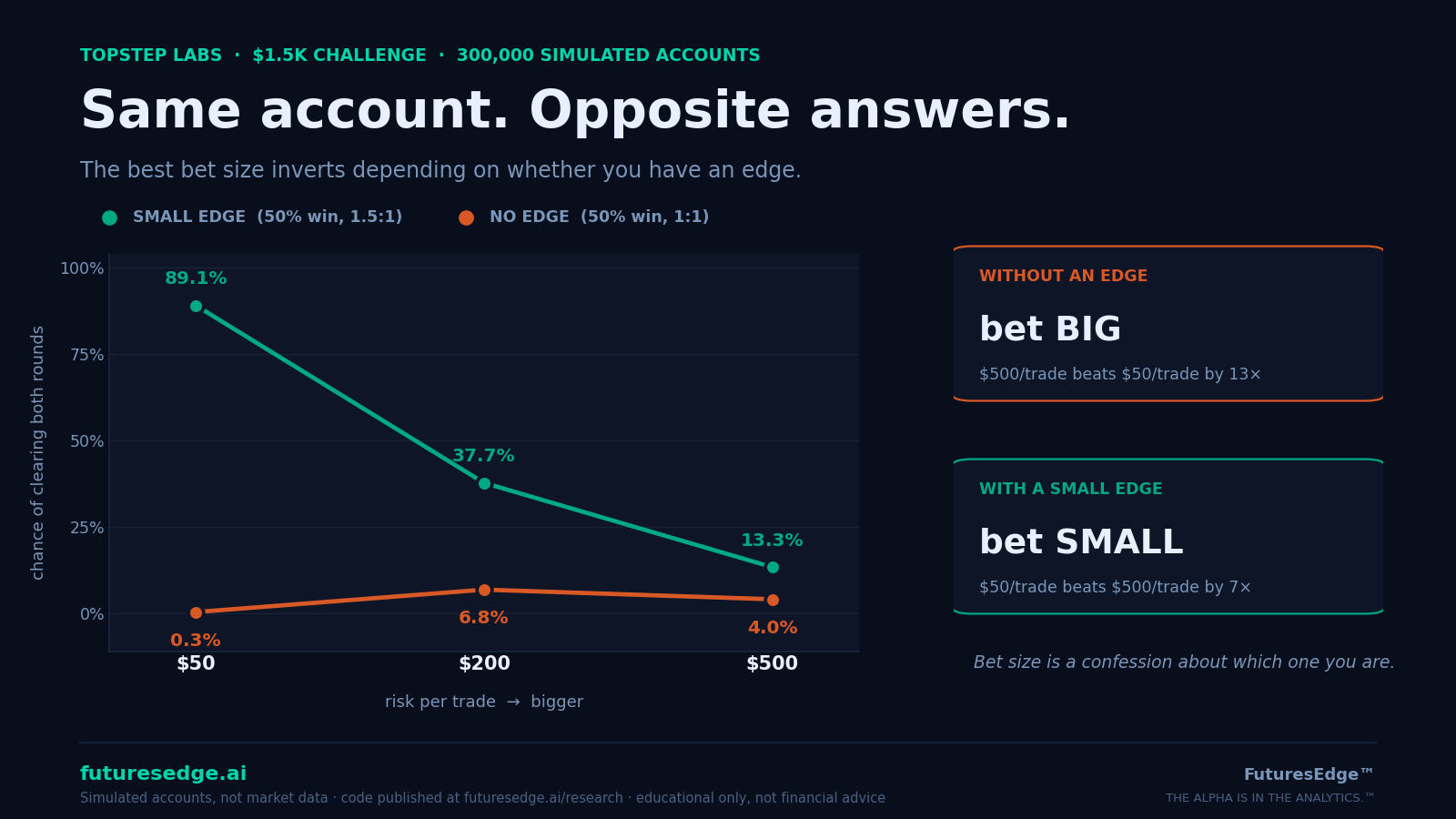
Here is the finding that surprised us, and it is the reason there is no single "right" way to trade this account. The optimal risk per trade inverts depending on whether you have an edge. Same account, same commission, same everything else:
| Risk per trade | Roughly | No edge (50%, 1:1) — clears both | Small edge (50%, 1.5:1) — clears both |
|---|---|---|---|
| $500 — the whole buffer | ~3–6 trades | 4.0% | 13.3% |
| $200 | ~10–15 trades | 6.8% | 37.7% |
| $50 | ~40+ trades | 0.3% | 89.1% |
$2.00 round-turn commission throughout. "Small edge" is +0.25R per trade.
Read the two right-hand columns against each other. Without an edge, small size is ruinous — 0.3% — because commission is a fixed tax and you are paying it hundreds of times on a coin flip. With an edge, small size is dominant — 89% — because more trades convert an edge into a near-certainty, and the commission is a rounding error against it.
Which means the decision is not a style preference. Sizing big and rare is the correct play if and only if you have no edge and are buying the cheapest possible lottery ticket. Sizing small and often is correct if and only if you have one. Choose the wrong one for who you actually are and you convert a 6.8% into a 0.3%, or an 89% into a 13%. The choice costs more than the trading does.
Three ways to size it — and what each one actually is
These are structures, not trade calls. No entries, no signals, no direction — just what each sizing regime demands of you and what the simulation says it returns. Educational only.
1. The three-day sprint. Roughly $500 of exposure at a time, aiming for about $500 a day, done in three or four sessions. On MNQ that is asking for ~125 points of net favourable movement per session — about a third of a normal daily range, so the target is entirely ordinary. The problem is the other side: the whole buffer is at risk in one position, and a normal day covers 125 points in both directions routinely. If the loss limit is measured on live equity — the open question above — a single 125-point adverse excursion ends it whether or not the move comes back. Simulation: 20% per round, 4% for both. Lowest commission of the three by a wide margin — roughly $8 of fees on a $1,500 target — at that trade count commissions genuinely are a rounding error. It is a cheap, fast, honest coin flip, and it is the best of the three if you have no edge. It is the worst of the three if you do.
2. The mid-size grind. Around $200 at risk per trade, ten to fifteen trades. This is the broad optimum for a trader with no measurable edge — the simulation peaks across a wide plateau roughly between $150 and $350, and the exact figure inside that band is noise, not signal. Commission is still small (~$25). Simulation: 26% per round, 6.8% for both with no edge, 37.7% with a small one. It is the least opinionated choice, which is why it is the sensible default when you genuinely don't know which trader you are.
3. Small and often. $50 or less per trade, forty or more trades. This is the only approach that ever produces a high probability — 89% for both rounds at +0.25R — and the only one that is close to hopeless without an edge, at 0.3%. It is a bet on your own statistics, not on the market. Commission (~$80 across the run) is the price of the sample size.
Every number on this page assumes a trader who sizes the same way on trade 40 as on trade 1. Remove the daily loss limit and put a hard floor $500 below the start, and the variable that decides the outcome stops being strategy and becomes whether you double up after two losses. If your history says you do, none of these rows describe you — the relevant number is how quickly you can cover 125 MNQ points, and the answer is usually "one afternoon." That number is already in your trade log.
What Topstep has since documented
When this went up, Drop #004 was on the marketing page but not in the Help Center. The parameter table has since been published, and it settles several things this article had listed as unknown. Both rounds start at a balance of $0 — the target is +$1,500 and the floor is −$500 from zero, not from an account size. Both rounds carry the same $500 static, non-trailing limit, the same $1,500 target, no daily loss limit, no consistency target, 2 micros and no minis. The payout round is a separate account and its activation is free. There are no resets — lose the buffer and that is the end of that account — and the purchase limit is 5 per trader. The published table lists no expiration, which is not the same as confirming there isn't one.
Two things still to confirm before you buy
Drop #004 is not yet documented in Topstep's Help Center — only the $25K Static, $250K Freedom and $3K Labs Challenges are. Two answers from the sibling products may or may not carry over, so get them in writing:
1. Whether the loss limit is measured on live equity or on closed balance. Undocumented for Labs, and the single most consequential unknown on this page — see the callout above.
2. Expiration. The drop page lists "No Min. Days," which is a statement about a minimum, not about an expiry, and the published parameter table does not mention one either way. Topstep's $3K Labs Challenge expires at 90 days and closes after 30 days of inactivity. If a clock applies here, the high-trade-count row above gets materially worse.
3. Your own commission, per side, per micro. It is the most consequential number in this article and the one nobody looks up. The difference between $0.50 and $1.00 a side is the difference between positive and negative expectancy on the fee.
The published table confirms the payout round is a separate account with its own fresh $500 static limit, which is what every "clears both" figure on this page assumed. That assumption is now documented rather than inferred.
The verdict
It is not a trap and it is not free money. At $39 for a fixed $1,500 with no split, the fee math is close enough to fair that the outcome is decided by three things the marketing never mentions: your commission rate, your maximum adverse excursion, and whether your sizing matches the trader you actually are. All three are already sitting in your fills. None of them is a matter of opinion.
Which of the three are you? Your fills already answer it.
FuturesEdge reads your actual trade history — win rate, average R, size variance, maximum adverse excursion, and the commission drag most traders never total — and computes what a given evaluation structure would do to you. Not a generic pass rate. Yours. Free for 2 firms, no card required.
Start FreeDrop #004 terms read from topstep.com/labs on September 2, 2026, and re-checked against the published parameter table in Topstep's Topstep Labs Help Center article on September 8, 2026 — which had not yet listed Drop #004 at first publication. Loss-limit mechanics quoted from Topstep's Maximum Loss Limit article; sibling-product terms from the Topstep Labs article. NQ daily range and ATR(14) figures by volatility regime from Volatility Box NQ research. Labs drops are explicitly experimental and limited — terms may change or be withdrawn; always confirm current rules in Topstep's official documentation before purchase. Method. This is a simulation of the account, not of the market. Each of the 300,000 runs per cell is one account: a sequence of independent trades at a fixed risk, each a win paying a set multiple of that risk or a loss, minus commission, repeated until the balance touches +$1,500 or −$500. No price data is used and none is implied — the trader is deliberately held constant so that what changes between rows is only the account structure and the bet size. The simulator is validated against a known answer: with no edge and no commission it must return $500 ÷ ($500 + $1,500) = 25.0%, and it does. Real trading has serial correlation, variable reward-to-risk and tilt, none of which this models. The code is published so you can check it or change the assumptions: labs-1500-montecarlo.py (Python 3, standard library only). Commission figures are assumptions spanning a realistic range, not quotes. Educational content only. Nothing here is financial advice, a trade recommendation, a signal, or a recommendation to purchase any evaluation. Futures trading involves substantial risk of loss. Topstep is a trademark of its owner; FuturesEdge is not affiliated with Topstep.